What Eats Army Worms and How to Stop the Invasion
Army worms can strip a Bermuda lawn bare in days. Here's what eats them, what draws them in, and exactly how to fight back before the damage gets out of hand.
Birds, ground beetles, parasitic wasps, ladybugs, lacewings, skunks, opossums, fire ants, and Bt all eat or kill army worms. None of them work fast enough to save a lawn during an active infestation. Scout in the early morning or evening, run a soap flush test, and treat at dusk if you find 2 or more worms per square foot.
Army Worms Are a Real Threat to Middle Georgia Lawns
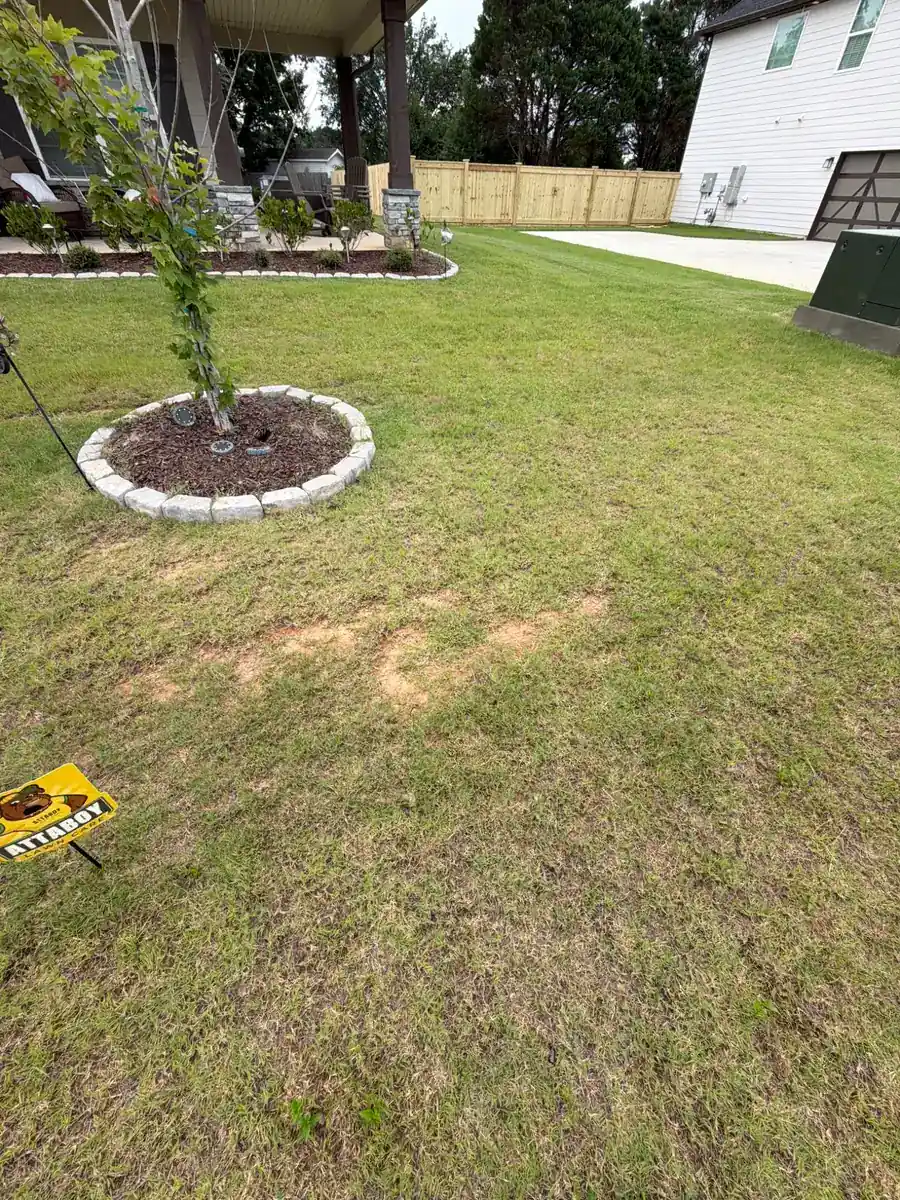
July and August are peak armyworm season in Middle Georgia. If you have walked outside and noticed large brown patches spreading across your Bermuda grass almost overnight, armyworms are the likely culprit. These are not slow-moving pests. A single egg mass can contain 100 to 200 larvae, and a full-blown infestation can strip a lawn bare in 24 to 48 hours.
The fall armyworm (Spodoptera frugiperda) is the species Macon, Warner Robins, Bonaire, and Kathleen homeowners deal with most. Despite the name, they show up in summer and peak from July through September. They are the larvae of a moth, so what you see chewing through your turf is the caterpillar stage. They feed hard, pass through six instars (growth stages), and then pupate in the soil. By the time most homeowners notice damage, the worms are already on their third or fourth instar and doing the most harm.
Understanding what eats them, what controls them, and what stops them from coming back puts you back in charge of your lawn.
What Eats Army Worms. Nature's Built-In Pest Control
A wide variety of birds, small mammals, and beneficial insects naturally prey on armyworms. Birds are the most visible predators. Robins, starlings, bluebirds, and other insect-eating birds consume large numbers of armyworm caterpillars from lawns and fields. If you see birds working your lawn in a concentrated feeding pattern, there is a good chance they have found worms.
Skunks and raccoons dig into turfgrass to feed on armyworms and other grubs. Opossums actively forage for ground-dwelling caterpillars and will work through a yard methodically at night. These mammals provide genuine population control. Their digging can be disruptive, but it signals a real infestation worth addressing.
Parasitic wasps lay eggs inside armyworm larvae. The eggs hatch and consume the pest from the inside, killing the larva before it can mature. Ladybugs and lacewings eat armyworm eggs and young hatchlings before they reach a damaging size. Ground beetles and spiders hunt caterpillars moving across the soil surface at night.
Fire ants, common throughout Middle Georgia, actively hunt armyworm larvae. They are a nuisance in their own right, but they do keep armyworm populations in check during an active outbreak.
Several naturally occurring pathogens also kill army worms. Bacillus thuringiensis var. kurstaki (Bt) (available under brand names like Dipel and Thuricide) is a soil bacterium that produces proteins that act on caterpillars once they eat a treated leaf and do not act on birds, bees, or mammals. The fungal pathogen Nomuraea rileyi can wipe out armyworm populations under humid conditions, something Middle Georgia summers provide reliably.
Natural predators rarely eliminate an active infestation fast enough to save your lawn. They are part of a long-term balance, not an emergency response. A lawn treated with harsh broad-spectrum pesticides loses these allies. And that can make future infestations worse.
Encourage birds by limiting broad-spectrum sprays that kill ground beetles and other predatory insects.
Bt-based products like Dipel and Thuricide leave beneficial insects alone and work well on small to medium infestations caught early.
Parasitic wasps lay eggs inside armyworm larvae. Broad pesticide applications disrupt this natural cycle.
Fire ants do predate on armyworm larvae. Factor that in before treating the perimeter during an active infestation.
What Brings Army Worms to Your Yard
Army worms do not randomly appear. Adult moths are drawn to well-lit areas at night, which is where they lay their eggs. Exterior lights left on overnight near your lawn create an attractant. Moths prefer to deposit eggs on lush, dense, actively growing grass, exactly what a healthy, well-fertilized Bermuda lawn looks like in July and August.
Bermuda grass is the top target in Middle Georgia. It stays dense, stays green deep into fall, and grows actively throughout summer. That is not a reason to avoid a healthy lawn. It means you need to stay alert during peak season.
Warm, humid summers accelerate armyworm reproduction cycles. Middle Georgia's heat and moisture allow moths to complete multiple generations per season. A yard can look clean in early July and be heavily damaged by mid-August. Neighboring properties with infestations also contribute. Adult moths fly, and larvae march from one lawn to the next, which is the origin of the name 'army' worm.
Excessive thatch buildup and overwatering make your lawn more attractive and harder to treat effectively. Thick thatch gives larvae a place to hide during the day, and wet conditions reduce the contact efficiency of some chemical treatments.
Turn off or redirect exterior lights away from your lawn during peak moth flight season in July and August.
Bermuda needs about 1 inch of water per week in summer, applied 2 to 3 times per week, not daily.
Mow consistently at 1 to 1.5 inches to reduce thatch and limit larval hiding spots.
Check neighboring lawns. If an adjacent property has an active infestation, yours may follow within days.
How to Spot Army Worms Before the Damage Gets Away From You
Early detection is everything. By the time large brown patches appear, worms have likely been feeding for several days. The goal is catching them before that point.
Walk your lawn in the early morning or evening. Armyworms feed most actively when temperatures drop, not at midday. Look for irregular brown patches that seem to appear suddenly. Check the edges of those patches, where active feeding is happening. Part the grass and look at the thatch layer. You are looking for olive-green to brown caterpillars with a distinctive inverted Y-shape on their head capsule.
A soap flush confirms their presence quickly. Mix 2 tablespoons of dish soap in a gallon of water and pour it over a square yard of lawn. Armyworms surface within a few minutes if they are present. Two or more worms per square foot means treat immediately. Do not wait.
Scout the unmowed edges of your property first. Moths often lay eggs near borders, and larvae tend to be most concentrated there before spreading inward across the lawn.
Scout early morning or evening. That is when armyworms are active and on the surface.
Soap flush test: 2 tablespoons of dish soap per gallon of water poured over a suspect area.
Two or more worms per square foot in the flush test is your threshold for immediate treatment.
Concentrated bird activity in one section of your lawn often signals worms feeding below.
What Kills Army Worms. Chemical Controls That Work
When an infestation is active and spreading, speed matters. Natural predators will not respond fast enough, and biological controls like Bt work best on early-instar larvae. For a full-blown infestation in Middle Georgia summer heat, synthetic pyrethroids are the standard response.
Bifenthrin, lambda-cyhalothrin, and permethrin are the most widely used active ingredients for armyworm control on turf. They work by disrupting the nervous system of larvae on contact and through ingestion. Most are available to homeowners in ready-to-spray hose-end formulations and are labeled for armyworm control on residential turf.
Chlorantraniliprole (sold under the trade name Acelepryn) is one of the most effective systemic options for fall armyworms. It moves through plant tissue so larvae ingest it as they feed. Residual control often runs four to six weeks, and it is significantly less disruptive to beneficial insects and pollinators than pyrethroids. The trade-off is cost. It runs higher than standard pyrethroid products.
Spinosad is a naturally derived but highly effective option for infestations where protecting beneficial insects is a priority. It is derived from a soil bacterium, works on contact and ingestion, and is OMRI listed. It carries some bee toxicity risk when applied to flowering plants, so avoid any blooming areas during application.
The most effective product depends on infestation severity and larval stage. Early instars are far easier to kill than late-stage larvae. A mature sixth-instar worm takes significantly more product to control. Another reason early detection pays off.
Common Army Worm Control Options at a Glance
| Product / Active Ingredient | Type | Best For | Residual |
|---|---|---|---|
| Bifenthrin / Lambda-cyhalothrin | Synthetic pyrethroid | Active infestations, all instars | 2–4 weeks |
| Chlorantraniliprole (Acelepryn) | Diamide (systemic) | Prevention and active infestations | 4–6 weeks |
| Spinosad | Naturally derived | Early instars, lower impact on beneficials | 1–2 weeks |
| Bacillus thuringiensis (Bt) | Biological | Early instars only | 3–7 days |
| Permethrin | Synthetic pyrethroid | Fast knockdown on active feeding | 1–3 weeks |
Best Time of Day to Spray, and What Keeps Army Worms Away
Spray at dusk. Armyworms feed most actively in the early morning and evening. Applying insecticide at dusk gives you the best chance of contacting larvae while they are on the surface and actively feeding.
Avoid midday applications. High heat causes many liquid insecticides to volatilize faster, reducing contact time on the turf. Direct midday sunlight also breaks down pyrethroid formulations more quickly, cutting residual effectiveness before it matters.
Hold off on irrigation for at least 24 hours after application. Watering immediately after spraying flushes active ingredients off leaf blades and into the soil before larvae can ingest them. Check the product label. Most specify a post-application watering window, and following it makes a real difference in results.
For prevention, keeping your lawn healthy without pushing excessive growth is a genuine deterrent. Over-fertilizing with nitrogen in summer drives rapid, soft growth that armyworm moths target for egg laying. We stop fertilizing by mid-September. Late nitrogen pushes lush turf exactly when moths are still active, and it makes the lawn more vulnerable heading into dormancy. Consistent mowing at 1 to 1.5 inches, thin thatch, and proper irrigation (1 inch per week, 2 to 3 times per week, never daily) all reduce the conditions armyworms exploit.
Some homeowners apply perimeter treatments along the property edge during peak season. This will not stop moths from laying eggs in the center of your lawn, but it can intercept marching larvae moving in from neighboring properties, a real concern in Middle Georgia neighborhoods where infestations can spread block by block.
Will Army Worms Go Away on Their Own, and What Won't They Eat
Each generation of army worms will complete its life cycle and pupate in the soil. But in Middle Georgia, fall armyworm moths can produce multiple generations between June and October. By the time one wave pupates, another generation may already be hatching. Waiting them out is a real gamble, especially if your Bermuda is actively being stripped.
Bermuda grass is resilient. If the soil and root system remain intact and soil temperatures are still warm, Bermuda can recover from armyworm defoliation. Severe damage late in the season (heading into October) leaves the lawn less able to recover before dormancy sets in around November. The window for recovery narrows fast once nighttime temperatures start dropping.
As for what army worms will not eat: they prefer warm-season grasses like Bermuda, but in high-population years they feed on most tender plant material, including corn, sorghum, and pasture grasses. Centipede and St. Augustine lawns in Centerville, Bolingbroke, and Byron see armyworm pressure too, though Bermuda is the primary target across Middle Georgia. Thick-leaved ornamentals, woody shrubs, and most trees are not on their menu. They need tender grass blades and soft leaf tissue.
If your lawn is actively being damaged right now, do not wait to see if they move on. The longer larvae feed, the more turf you lose, and the harder recovery becomes heading into fall.
How Attaboy Lawn Care Handles Armyworm Pressure
Our core program covers weed control and fertilization for lawns across Macon, Warner Robins, Byron, Bonaire, Centerville, Kathleen, Bolingbroke, and surrounding areas in Middle Georgia. Insect control, including armyworm treatment, is available as an add-on service.
We use a flat monthly rate with no contracts. Cancel anytime. After every visit, we send a treatment report so you know exactly what was applied and when.
If you are seeing suspicious brown patches or want to get ahead of peak armyworm season before the next generation hatches, call us at (478) 400-9897 or request a Get Quote online. We can typically get a first treatment on the calendar fast. And we will tell you upfront what your lawn actually needs before we touch it.
Key takeaways
What to Remember
Birds, ground beetles, parasitic wasps, skunks, opossums, and Bt all prey on or kill army worms. But natural controls alone will not stop an active infestation.
Bifenthrin, lambda-cyhalothrin, and chlorantraniliprole (Acelepryn) are the most effective chemical controls for fall armyworms on Middle Georgia turf.
Spray at dusk when armyworms are most active on the surface, and hold off on irrigation for at least 24 hours after treatment.
Moths target well-lit areas and lush Bermuda. Turning off exterior lights and avoiding excess nitrogen fertilization in summer reduces your risk.
Use the soap flush test (2 tablespoons dish soap per gallon of water) to confirm an infestation before treating. Two or more worms per square foot means act now.
Middle Georgia sees multiple armyworm generations per season between June and October. Waiting them out risks serious damage with a narrowing recovery window before dormancy.
Common questions
Frequently Asked Questions
What kills army worms instantly?
Synthetic pyrethroids like bifenthrin and lambda-cyhalothrin provide the fastest knockdown. Most products kill larvae on contact within hours. Apply at dusk when armyworms are actively feeding on the surface, and avoid watering for 24 hours after application. No product provides truly instant control across a full infestation, but pyrethroids come closest for active, widespread damage.
Will armyworms eventually go away on their own?
Each generation will complete its life cycle and pupate in the soil. But in Middle Georgia, fall armyworm moths produce multiple generations between June and October. By the time one wave passes, another may already be hatching. Waiting them out is a gamble, particularly if your Bermuda is actively being stripped and the recovery window before fall dormancy is closing.
What will army worms not eat?
Army worms prefer warm-season grasses like Bermuda, but will feed on most tender plant material when populations are high. They generally avoid thick-leaved ornamentals, woody shrubs, and most trees. In Middle Georgia, Bermuda is the primary target, though centipede and St. Augustine lawns also see damage during heavy infestation years.
What keeps army worms away?
Turn off exterior lights during peak moth flight season in July and August. Moths are attracted to light and lay eggs near illuminated areas. Avoid over-fertilizing with nitrogen in summer, which drives the lush soft growth moths seek for egg laying. Keep thatch thin, mow Bermuda at 1 to 1.5 inches, and consider a perimeter bifenthrin treatment during peak season as a preventive barrier against marching larvae.
What brings army worms to your yard?
Adult moths are attracted to light and lay eggs on dense, actively growing grass. A healthy, well-fertilized Bermuda lawn in July or August is prime egg-laying territory. Middle Georgia's warm, humid summers allow multiple generations per season, and neighboring infestations can send larvae marching into your yard within days, which is exactly how they earned the name 'army' worm.
What is the most effective chemical to control fall armyworms?
Chlorantraniliprole (sold as Acelepryn) is widely considered the most effective systemic option. It offers a four to six week residual and is less disruptive to beneficial insects than pyrethroids. For fast knockdown on an active infestation, bifenthrin or lambda-cyhalothrin are the standard choice. Spinosad is a naturally derived alternative that works well on early-instar larvae with lower impact on beneficial insect populations.
What time of day is best to spray for armyworms?
Dusk is the best time to spray. Armyworms feed most actively in the early morning and evening when temperatures drop. Applying at dusk means hitting larvae while they are on the surface and actively feeding. Midday applications lose effectiveness quickly. Heat accelerates product breakdown and worms retreat into the thatch during peak heat anyway.
What natural insecticide can I use to get rid of armyworms?
Bacillus thuringiensis var. kurstaki (Bt) is the most widely available natural option. Look for Dipel or Thuricide at garden centers. It works by disrupting the digestive system of young caterpillars, does not act on birds, bees, or mammals, and like any product is applied by the label. Spinosad is another naturally derived option with stronger knockdown on larger larvae. Both work best on early-instar worms, so early detection is essential.
Keep reading
Related Resources
More in Pest & Disease Alerts
Written by Tyler Warnock
Founder and owner of Attaboy Lawn Care in Macon, Georgia. Licensed Georgia pesticide applicator (Cat. 24, #22324). Tyler treats lawns across Macon, Warner Robins, and the rest of Middle Georgia, and writes these guides from what the region’s bermuda, zoysia, and centipede yards actually do season to season.
Ready for results?
Get a Custom Quote for Your Lawn
Professional lawn care for Macon, Warner Robins, and Middle Georgia. No contracts, no obligation.