
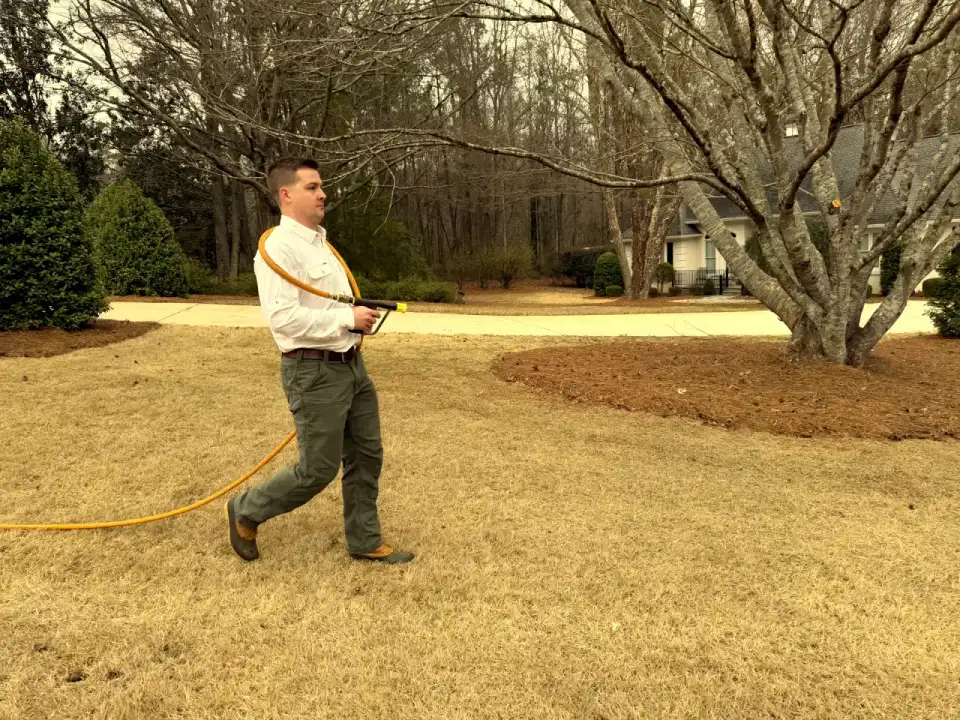
Chinch Bug Damage on St. Augustine Grass
Chinch bugs target St. Augustine grass almost exclusively. If your St. Augustine is browning in sunny areas despite watering, chinch bugs may be the cause.
Chinch bugs pierce St. Augustine blades and inject a toxin that blocks water movement, so the grass browns along driveways, sidewalks, and south-facing edges and does not recover with watering. Confirm it with the soapy water flush test, 2 tablespoons of dish soap per gallon of water. We treat preventively in late May or early June, before populations multiply.
Why Chinch Bugs Target St. Augustine
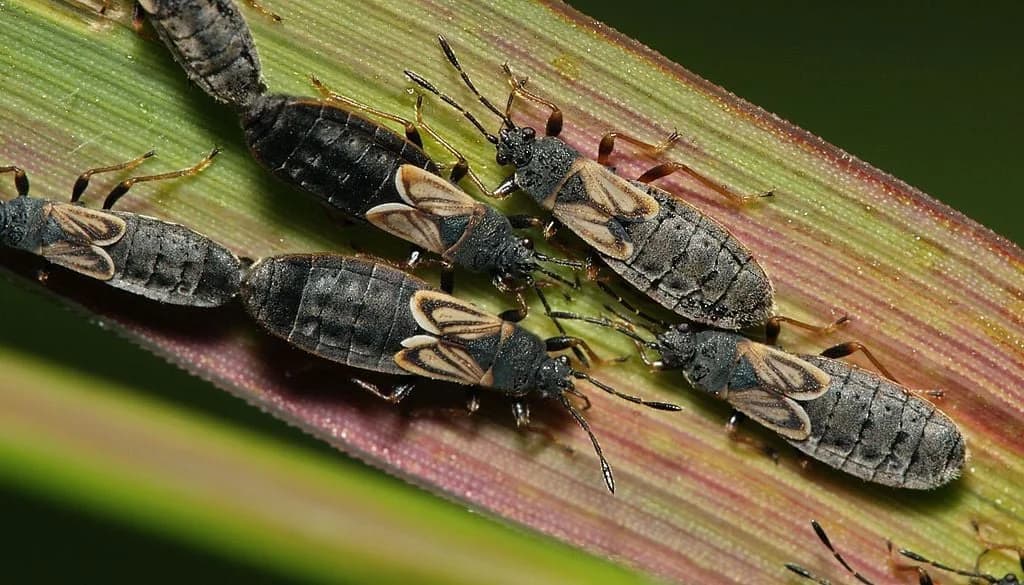
Southern chinch bugs (Blissus insularis) have a strong preference for St. Augustine grass. They feed by piercing grass blades and sucking out plant fluids while injecting a toxin that blocks water movement within the plant. The result looks like drought stress: browning, wilting grass. But watering does not fix it. Chinch bugs thrive in hot, sunny, dry conditions, making Georgia summers prime feeding time.
St. Augustine is one of the thirstiest warm-season grasses. It needs more water than bermuda or zoysia, and it shows stress faster during dry spells. Chinch bugs exploit this weakness. They target grass that is already working hard to stay hydrated, then inject a toxin that shuts down the plant's ability to move water through its tissues. It is a one-two punch that kills turf fast.
Homeowners in Bonaire, Kathleen, and parts of south Macon who have St. Augustine lawns need to be especially vigilant from June through September. Chinch bugs are not just a nuisance. They can kill large sections of turf permanently if populations go unchecked. Early detection is the difference between a treatable problem and a re-sodding job.
Identifying Chinch Bug Damage
Chinch bug damage starts in the sunniest, driest areas of your lawn, along sidewalks, driveways, and south-facing edges. It spreads outward from these hot spots. The grass turns yellow, then brown, and eventually dies. Unlike drought stress, chinch bug damage does not recover with watering. Adult chinch bugs are tiny (about one-sixth of an inch) with black bodies and white wings.
The damage pattern is the biggest clue. Chinch bugs congregate where heat radiates from hard surfaces. Concrete driveways, sidewalks, and patios absorb heat during the day and release it into adjacent turf. That microclimate is exactly what chinch bugs prefer. If your brown patches follow the edges of hardscape and radiate outward, chinch bugs are the likely culprit.
To confirm, get down on your hands and knees at the border between healthy and damaged grass. Part the blades and look at the soil surface and lower stems. Chinch bugs are small but visible. Adults are black with white wings folded flat across their backs. Nymphs are bright red-orange with a white stripe across the abdomen. You will see them moving through the thatch layer. The soapy water flush test also works: pour a mixture of 2 tablespoons of dish soap per gallon of water over a suspect area and chinch bugs will float to the surface within minutes.
Part the grass at the edge of a damaged area and look for small black and white insects.
The soapy water flush test works for chinch bugs too. They float to the surface.
Damage patterns that follow sunny edges and do not respond to water suggest chinch bugs.
Nymphs are bright red-orange with a white band. They are easier to spot than the dark adults.
The Chinch Bug Life Cycle in Georgia
Chinch bugs overwinter as adults in thatch, leaf litter, and other sheltered spots in your lawn. When soil temperatures warm up in April and May, they emerge and begin feeding. Females lay eggs in leaf sheaths and thatch, producing 250 to 300 eggs over their lifetime. Eggs hatch in about two weeks.
Nymphs go through five growth stages over 4 to 6 weeks before reaching adulthood. Each stage feeds on grass sap. In Middle Georgia, chinch bugs produce two to three generations per season. The first generation in spring usually causes minor damage. The second and third generations in July through September are the ones that destroy lawns, because populations have multiplied exponentially by then.
This is why preventive treatment in late May or early June is so effective. You are knocking out the first generation before it produces offspring. Every female stopped then is 250 to 300 eggs that never hatch, and the generations those eggs would have fed never build. Wait until August and you are fighting an army.
Chinch Bugs vs Other Lawn Problems
Chinch bug damage gets confused with three other common lawn problems: drought stress, large patch disease, and take-all root rot. All four cause brown patches in St. Augustine. Here is how to tell them apart.
Drought stress affects the entire lawn somewhat evenly, with the worst areas in full sun. It recovers with watering within 24 to 48 hours. Chinch bug damage does not recover with water and concentrates along hardscape edges. Large patch disease creates circular patches with an orange-brown border and appears in spring and fall when temperatures are cooler, not in peak summer heat. Take-all root rot causes irregular yellowing with black, rotting roots visible when you pull the grass up.
If you are not sure what you are dealing with, do the soapy water flush test. It takes five minutes and gives you a definitive answer for chinch bugs. For disease questions, pull up a section of affected grass and examine the roots and stolons. Black, mushy roots point to disease. Clean white roots with no insects in the soil point to environmental stress.
Treatment and Prevention
Insecticides containing bifenthrin or imidacloprid control chinch bug populations effectively. Apply to the entire lawn, not just damaged areas, because chinch bugs spread outward from initial feeding sites. Preventive applications in late May or early June stop populations before they build to damaging levels. Maintaining proper irrigation helps too. Chinch bugs prefer stressed, drought-weakened turf.
For active infestations, liquid insecticide applications provide the fastest knockdown. Spray the entire lawn with emphasis on the damaged areas and a 10-foot buffer around them. Water the product in lightly after application. A follow-up application 3 to 4 weeks later catches the next generation of nymphs hatching from eggs that survived the first treatment.
Our insect control add-on covers chinch bug prevention and treatment for St. Augustine lawns in the Middle Georgia area. We time applications based on local conditions and chinch bug activity reports. If your St. Augustine is showing stress along driveways and sidewalks, get a quote before the damage spreads further.
Cultural Practices That Reduce Chinch Bug Risk
Proper lawn care makes St. Augustine less attractive to chinch bugs and more resilient if they do show up. Start with irrigation. St. Augustine needs about 1 inch of water per week during summer, split into two or three deep watering sessions. Consistent moisture keeps the grass healthy and makes the microenvironment less favorable for chinch bugs.
Thatch management matters too. Chinch bugs harbor in thick thatch layers where they are protected from predators and insecticide sprays. If your St. Augustine has more than half an inch of thatch, it is providing chinch bugs a safe haven. Dethatching or vertical mowing in early summer reduces this hiding spot. Do not over-fertilize, as excess nitrogen drives thatch buildup.
Mow at the right height. St. Augustine should be maintained at 3 to 4 inches. Cutting it too short stresses the grass and makes it more vulnerable to both chinch bugs and heat damage. A taller canopy shades the soil, retains moisture, and creates a less hospitable environment for chinch bugs that prefer hot, exposed conditions.
Lawn Recovery After Chinch Bug Damage
St. Augustine grass has good recovery ability if the damage is caught early. Once chinch bugs are controlled, resume normal watering and apply a balanced fertilizer to encourage regrowth. Severely damaged areas where the grass died completely may need re-sodding. St. Augustine does not fill in from seed. Sod or plugs are the only options for bare areas.
For moderate damage where the stolons are still alive, recovery takes 4 to 6 weeks with proper care. Water deeply twice a week and apply a slow-release fertilizer with iron to push green-up. Avoid heavy nitrogen applications, as stressed turf is already vulnerable and pushing too much growth too fast invites disease, especially large patch in the fall.
If the grass is completely dead in sections, do not wait months hoping it fills in. St. Augustine spreads by stolons, and it moves slowly compared to bermuda. A 3-foot bare patch can take an entire growing season to fill from the edges. Laying fresh sod gets you back to a full lawn in weeks instead of months. Water new sod daily for the first 10 to 14 days, then gradually reduce to a normal schedule.
When to Call a Professional
Small chinch bug populations caught early can be managed with over-the-counter products from the garden center. If the damage is limited to a few square feet along a driveway edge and you catch it in June, a consumer bifenthrin spray may be all you need.
Call a professional when the damage is spreading fast, covers a large area, or keeps coming back despite treatment. Professional-grade products penetrate thatch better and provide longer residual control than consumer formulations. We also know the treatment timing and rates that work best for Middle Georgia's St. Augustine lawns.
If you have been fighting chinch bugs year after year, a reactive approach is not working. Our insect control add-on provides preventive treatment timed for the Middle Georgia chinch bug season. We treat before populations explode rather than after damage appears. Get a quote to protect your St. Augustine lawn this season.
Key takeaways
What to Remember
Chinch bugs target St. Augustine grass almost exclusively. Damage appears first along driveways, sidewalks, and south-facing edges.
The soapy water flush test is the fastest way to confirm chinch bugs. Mix 2 tablespoons of dish soap per gallon of water and pour over a suspect area.
Preventive treatment in late May or early June stops the first generation before it multiplies. This is far more effective than treating active infestations in August.
Chinch bug damage does not recover with watering. If brown patches persist despite irrigation, check for insects.
Proper irrigation, mowing height, and thatch management make St. Augustine less attractive to chinch bugs.
St. Augustine does not grow from seed. Severely damaged areas require sod or plugs to repair.
Common questions
Frequently Asked Questions
How do I know if I have chinch bugs?
Watch for irregular yellow patches turning brown near driveways and heat-absorbing edges. Part the grass at the damaged edge and check for small black-and-white insects. The soapy water flush test also confirms their presence.
Can St. Augustine recover from chinch bug damage?
Yes, if damage is caught early and the lawn receives proper treatment, watering, and fertilization. Moderately damaged areas recover in 4 to 6 weeks. Severely damaged areas where the grass died completely need sod replacement.
Why do chinch bugs always damage the same areas?
Chinch bugs prefer hot, dry microenvironments. Concrete driveways, sidewalks, and patios absorb and radiate heat, creating ideal conditions along their edges. These areas also dry out faster, stressing the grass and making it more vulnerable.
What is the best time to treat for chinch bugs?
Late May or early June for preventive treatment, before the second generation hatches and populations explode. For active infestations, treat immediately upon discovery and follow up 3 to 4 weeks later.
Do chinch bugs affect bermuda or zoysia grass?
Southern chinch bugs strongly prefer St. Augustine. They occasionally feed on other grasses but rarely cause significant damage to bermuda or zoysia. If you have bermuda and are seeing brown patches, look for other causes like grubs, drought, or disease.
How can I prevent chinch bugs naturally?
Proper irrigation, correct mowing height (3 to 4 inches for St. Augustine), and thatch management reduce chinch bug pressure. Healthy, well-watered turf is less attractive to chinch bugs and more resilient if they do feed.
Keep reading
Related Resources
More in Pest & Disease Alerts
Written by Tyler Warnock
Founder and owner of Attaboy Lawn Care in Macon, Georgia. Licensed Georgia pesticide applicator (Cat. 24, #22324). Tyler treats lawns across Macon, Warner Robins, and the rest of Middle Georgia, and writes these guides from what the region’s bermuda, zoysia, and centipede yards actually do season to season.
Ready for results?
Get a Custom Quote for Your Lawn
Professional lawn care for Macon, Warner Robins, and Middle Georgia. No contracts, no obligation.