
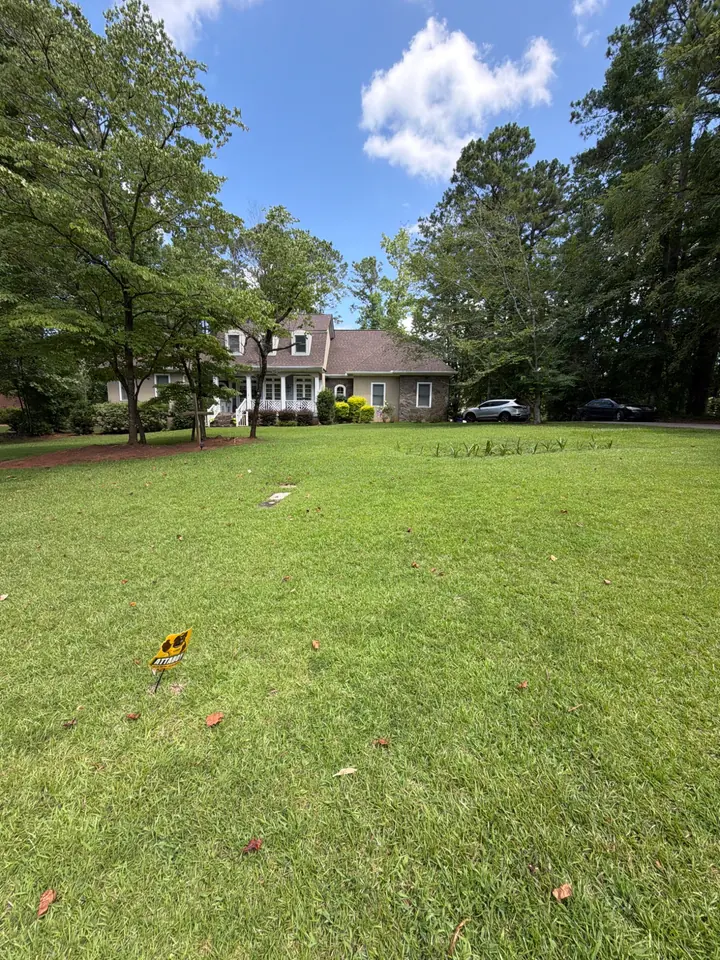
Crabgrass Control in Middle Georgia Bermuda Lawns
Those flat, light-green clumps spreading from the driveway edge are crabgrass. Here is how we identify it on Middle Georgia Bermuda, the three causes we find behind a breakthrough, and what we do about it in fall and again in spring.
Crabgrass is a summer annual grass that germinates once soil reaches 53 to 58 degrees at the 4-inch depth. The reliable control is a pre-emergent applied late February to mid March, before soil hits 55 degrees, with a second application 6 to 8 weeks later. Clumps already up need a post-emergent labeled for your turf species. Frost kills the plant, but its seed stays in your soil.
The Flat Light-Green Clumps Along Your Driveway
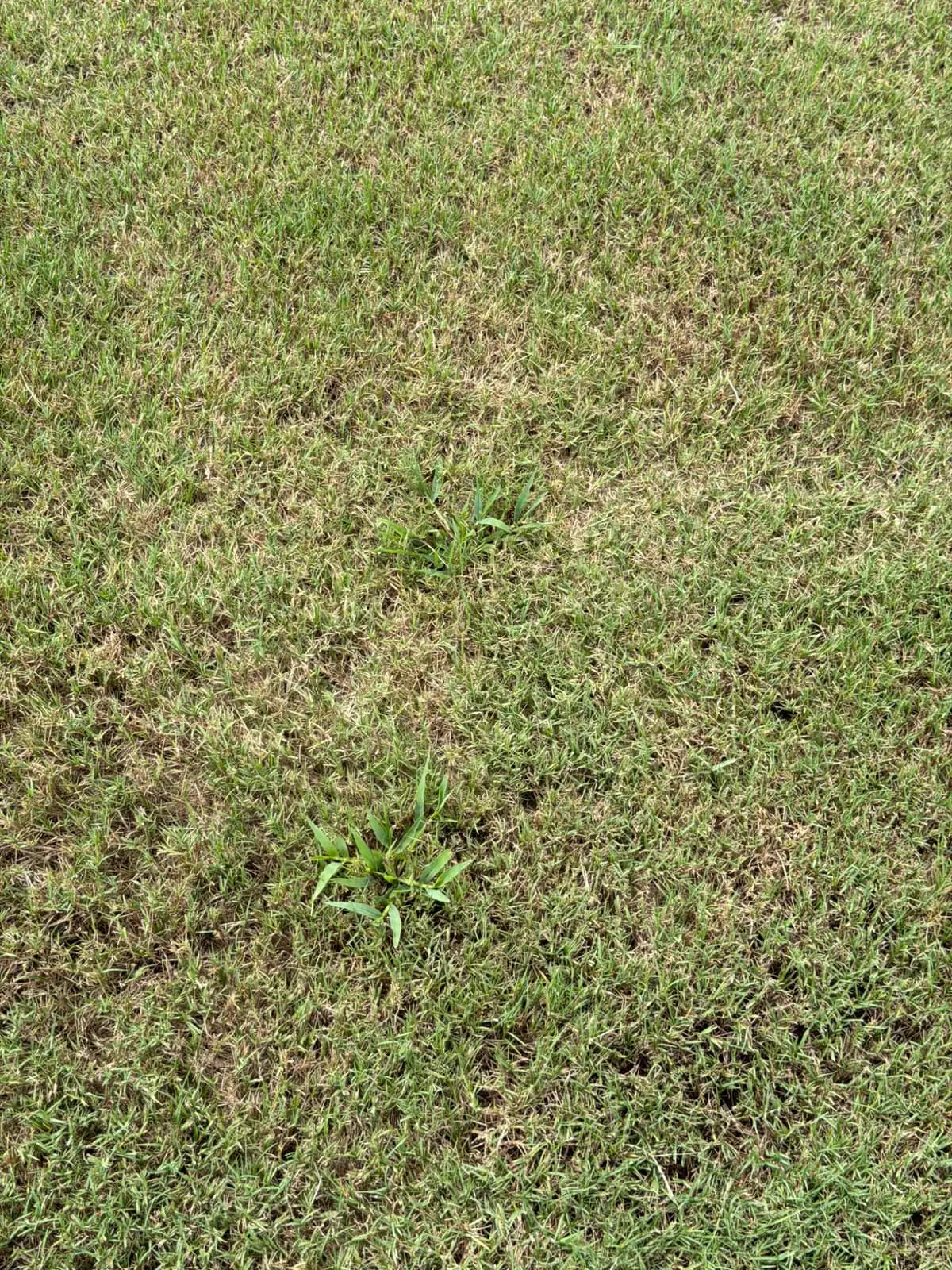
Crabgrass is the coarse, pale-green grass that sprawls flat along driveway edges and mailbox strips in Middle Georgia lawns. It sits lower and wider than Bermuda, with fatter blades and stems radiating from one center crown like a starfish. It takes hold where the turf thinned out and where concrete reflects heat into the soil.
The color is only part of why it bothers people. It grows faster than Bermuda in July heat, so two days after you mow it is standing above the lawn again. The texture is wrong. Where a clump sits, your Bermuda is not growing, because crabgrass takes the water, the light, and the root space.
The other thing homeowners notice: it was not there in April and by late June it is everywhere. That is not bad luck. That is the germination window closing behind a pre-emergent barrier that either was not there or had worn thin.
The Three Causes We Actually Find Behind a Breakthrough
When crabgrass shows up in a Bermuda lawn here, one of three things happened. In order of how often we find them: the pre-emergent went down late, the barrier broke down before the germination window closed, or the turf was too thin to compete and the weed won an open seedbed.
Cause one is timing. University of Georgia Extension puts crabgrass germination at soil temperatures of 53 to 58 degrees, read at the 4-inch depth on the UGA Weather Network, which in Middle Georgia means late February to mid March. A pre-emergent applied in April is a post-emergent problem wearing the wrong label. The seed already broke. Soil does not warm evenly across the region either. A south-facing yard pressed against a concrete driveway will cross the threshold sooner than a shaded lawn on heavy clay to the north, so the 4-inch reading beats the calendar date and beats the old forsythia-bloom rule.
Cause two is barrier life. One application does not carry you from March to July. Late June brought a lot of crabgrass breakthroughs in Bermuda lawns across Macon and Warner Robins this year, except on the lawns where we had reapplied pre-emergent. The second application is what held. Rain, irrigation, and red clay heat all work the chemical barrier down over time.
Cause three is thin turf. Crabgrass is an opportunist. It needs light hitting bare soil to get going, which is why it starts at the driveway edge where heat reflects and the Bermuda struggles. We see the same pattern with spurge. Spurge took over a lot of Macon lawns in July wherever the pre-emergent barrier was weak or missing, and it moved in fast on thin, sun-baked turf. Same open ground, different weed.
How We Tell Them Apart in the Field
Three grassy weeds get called crabgrass in Middle Georgia and only one of them is. We separate them by growth habit, blade width, and what comes up when you pull. Do this in the morning while the lawn is still damp, when the plants are upright and easy to read.
Crabgrass: pull one clump and the whole thing lifts as a shallow mat of fibrous roots. Stems radiate flat from a single crown. Blades are wide and slightly hairy at the base. It is an annual, so there is no rhizome, no underground runner, nothing creeping.
Dallisgrass: looks similar from the driveway, but dig it and you hit a thick, woody crown that does not lift. Seedheads are tall and sparse with black specks. It comes back from the same spot year after year, which crabgrass never does.
Nutsedge: stand over it and look down the stem. Triangular, not flat. It grows taller than everything around it within two days of mowing, and when you pull it you find a small nut-like tuber on the root. That one needs a different chemistry entirely, which is why we treat yellow nutsedge as its own problem.
Goosegrass: the center of the clump is pale white or silver, flattened like a crushed fan. It likes compacted ground, so we find it on footpaths and parking strips. It germinates later in the season than crabgrass, after soils have warmed well past the crabgrass window.
Field identification of grassy weeds we find in Middle Georgia lawns
| Weed | Growth habit | What you find when you pull it | Life cycle |
|---|---|---|---|
| Crabgrass | Flat, spreading from one center crown | Shallow fibrous mat, lifts easily | Summer annual |
| Dallisgrass | Coarse clump, upright | Thick woody crown, stays put | Perennial |
| Yellow nutsedge | Upright, faster than the turf | Triangular stem, small tuber on root | Perennial |
| Goosegrass | Flattened rosette, silver center | Tough root in compacted soil | Summer annual |
Check in the morning, while dew is on the lawn. Wilted midday turf hides growth habit.
Roll the stem between your fingers. Round or flat means a grass. Triangular means a sedge.
Pull a whole plant, do not snap the top. The roots and crown are where the answer is.
Mark the clump locations with a photo on your phone. Next March that is your map for where the barrier failed.
What Actually Kills It, and When
Crabgrass control comes down to one question: has the seed germinated yet. Before it germinates, a pre-emergent herbicide stops it in the soil. After it germinates, you need a post-emergent labeled for your turf species, and you are now removing a plant that already took space from your Bermuda. The difference between the two approaches is covered in full on our pre-emergent vs post-emergent page.
Lawn pre-emergents are built on active ingredients such as prodiamine, dithiopyr, or pendimethalin. On Bermuda here, the spring application goes down late February to mid March, before soil temperature reaches 55 degrees at the 4-inch depth, with a second application 6 to 8 weeks later to carry the barrier through the rest of the germination window. UGA Extension's Newton County office makes the same point about getting ahead of soil temperature rather than the calendar date in Prevent Crabgrass.
Fall pre-emergent runs mid September to mid October. That one is not aimed at crabgrass, which is done for the year. It targets the winter annuals, poa annua and henbit and chickweed, that germinate as soil cools. Skipping it means a lawn full of weeds in February right when you are trying to scalp.
For crabgrass already up, quinclorac is the selective active ingredient most often used on warm-season lawns, and some labels call for a surfactant or methylated seed oil so the spray holds on the waxy blades. Spray below 90 degrees, which in a Middle Georgia July means early morning or evening. Zoysia and Centipede are more sensitive than Bermuda and the product list is shorter, so the label matters more, not less. Tyler Warnock holds a Georgia commercial pesticide applicator license (Category 24, Ornamental and Turf Pest Control, license #22324) from the Georgia Department of Agriculture, and we follow the label on every product we apply. Read the label on anything you buy yourself, and check that the product is registered through the Georgia Department of Agriculture.
Skip the home remedies. Vinegar and baking soda burn the top of the plant and whatever Bermuda they land on, and the crabgrass crown survives to push new growth. Non-selective products like glyphosate kill crabgrass and your Bermuda in the same spot, which leaves bare clay for the next weed.
Water the lawn in after a pre-emergent application. The barrier forms in the top layer of soil, not on the leaf.
Do not core aerate right after a spring pre-emergent. Pulling plugs opens holes in the barrier.
Mow Bermuda at 1 to 1.5 inches. Lower than that thins the stand and opens ground for crabgrass next spring.
Keep pets and kids off the lawn until it's dry after any application.
Crabgrass in October, and Why Fall Still Matters
By October the crabgrass in your lawn is finishing its life. It is a summer annual, and first frost kills the plant outright. Bermuda dormancy here runs roughly November through February, and the crabgrass browns out ahead of it. You do not need to spray it in October to make it go away.
What you do need to remember is that every clump dropped seed into your soil through August and September. That seed sits there all winter waiting on 53 to 58 degree soil at the 4-inch depth. Killing the parent plant in October changes nothing about next June.
So the October job is the fall pre-emergent for winter annuals, and the March job is the crabgrass barrier. Two different applications, two different targets, both part of a year-round weed control program.
What We Would Do on Your Lawn This Year
First visit, we walk the lawn and identify what is actually out there. Crabgrass, dallisgrass, nutsedge, and goosegrass all get treated differently, and guessing wrong wastes a season. We note where the thin spots are, because those are the places the barrier has to hold hardest next spring.
Between now and mid October, fall pre-emergent goes down for the winter annuals. Late February to mid March, the spring crabgrass barrier goes down before soil hits 55 degrees at the 4-inch depth, and 6 to 8 weeks after that we come back and reapply. That second application is the one most DIY programs skip, and it is the one that held the line on our Bermuda lawns this past June. The full calendar is laid out on our when to apply pre-emergent in Georgia page.
Alongside that, fertilization keeps the Bermuda thick enough to close the gaps on its own. Generic crabgrass advice is often written with cool-season grasses like fescue in mind, not Bermuda. Bermuda gets cut at 1 to 1.5 inches, and a dense stand at that height shades the soil, so crabgrass seed that never sees light never germinates. Weed control and fertilization are our core program, and we run 6 to 8 treatments a year, about every 6 to 8 weeks.
Plans start at $39 a month. No contract, no sign-up fee required, cancel any time. Sign up and your lawn is treated within 24 hours. If weeds come back between visits, or your lawn isn't improving, we come back and re-treat at no charge. We text you when the visit is done and what we applied, and you get a treatment report after every visit. Keep pets and kids off the lawn until it's dry.
We treat lawns in Macon, Warner Robins, Byron, Bonaire, Centerville, Kathleen, and Bolingbroke. If you want someone to look at it first, use Get Quote and we reply within 24 hours. Call (478) 400-9897 or see what we handle on Macon lawn care.
Key takeaways
What to Remember
Crabgrass germinates at 53 to 58 degrees soil temperature at the 4-inch depth, which puts the spring pre-emergent window in Middle Georgia at late February to mid March, before soil reaches 55 degrees.
One pre-emergent application does not last the season. The reapplication 6 to 8 weeks later is what prevented the June breakthroughs we saw this year.
Pull the plant to identify it. Crabgrass lifts as a shallow fibrous mat, dallisgrass holds on with a woody crown, and nutsedge has a triangular stem and a tuber.
Fall pre-emergent in mid September to mid October targets winter annuals, not crabgrass. Crabgrass dies at first frost but leaves seed behind.
Vinegar, baking soda, and non-selective products damage Bermuda as readily as the weed. Use a selective post-emergent labeled for your turf and follow the label.
Thick Bermuda at 1 to 1.5 inches shades the soil and stops crabgrass seed from getting the light it needs.
Common questions
Frequently Asked Questions
What will kill crabgrass but not your lawn?
A selective post-emergent herbicide labeled for your turf species. Quinclorac is the active ingredient most often used on warm-season lawns, and on Bermuda there are several options. On Zoysia and Centipede the list is shorter, because those grasses are more sensitive to the chemistry that takes crabgrass out. Read the label and confirm your grass is listed on it. We follow the label on every product we apply.
Is July too late to kill crabgrass?
No, but it is late. A post-emergent will still take out established clumps in July, and we treat plenty of them. What July cannot do is prevent the seed those plants already dropped. The plant is larger and harder to kill than it was in May, and it has already taken space from your Bermuda. Prevention in late February to mid March is the cheaper fight.
How do you get rid of crabgrass fast?
Spot-treat with a selective post-emergent labeled for your grass, then give the Bermuda what it needs to fill the gap: 1 inch of water a week in summer, deep and infrequent, 2 to 3 times a week, and mowing at 1 to 1.5 inches. Hand-pulling works on a few clumps if you get the whole crown. Nothing is instant. The plant browns out over days, not hours.
What is the strongest crabgrass killer?
Fit matters more than strength. Quinclorac is the active ingredient most commonly used to remove crabgrass from an established lawn without taking the turf with it, and the label tells you which grasses it is cleared for. A non-selective product kills more, including your Bermuda, and leaves bare clay for the next weed. A pre-emergent in March beats any post-emergent in July.
Can crabgrass spread by mowing?
Mowing does not spread crabgrass by root, because it has none that creep. It can carry seed on the deck and tires from a seedy patch to a clean part of the lawn. If one area is loaded with seedheads, mow it last and blow the deck off afterward. The bigger spread risk is leaving thin, bare soil for seed to land on.
Will crabgrass eventually go away on its own?
The plant will. Crabgrass is a summer annual and first frost kills it outright. The seed does not go away. It overwinters in your soil and germinates the next spring once soil reaches 53 to 58 degrees at the 4-inch depth. Without a pre-emergent barrier down from late February to mid March, the same lawn gets it again every June.
Is it better to spray or pull crabgrass?
Pull it if you have five clumps and you can get the whole crown. Spray it if you have fifty. Pulling leaves a hole in the turf that the next weed fills, so either way you want the Bermuda growing in behind it. For a lawn with widespread crabgrass, a labeled post-emergent now plus pre-emergent next March is the combination that changes the outcome.
Keep reading
Related Resources
More in Lawn Tips
Written by Tyler Warnock
Founder and owner of Attaboy Lawn Care in Macon, Georgia. Licensed Georgia pesticide applicator (Cat. 24, #22324). Tyler treats lawns across Macon, Warner Robins, and the rest of Middle Georgia, and writes these guides from what the region’s bermuda, zoysia, and centipede yards actually do season to season.
Ready for results?
Get a Custom Quote for Your Lawn
Professional lawn care for Macon, Warner Robins, and Middle Georgia. No contracts, no obligation.