
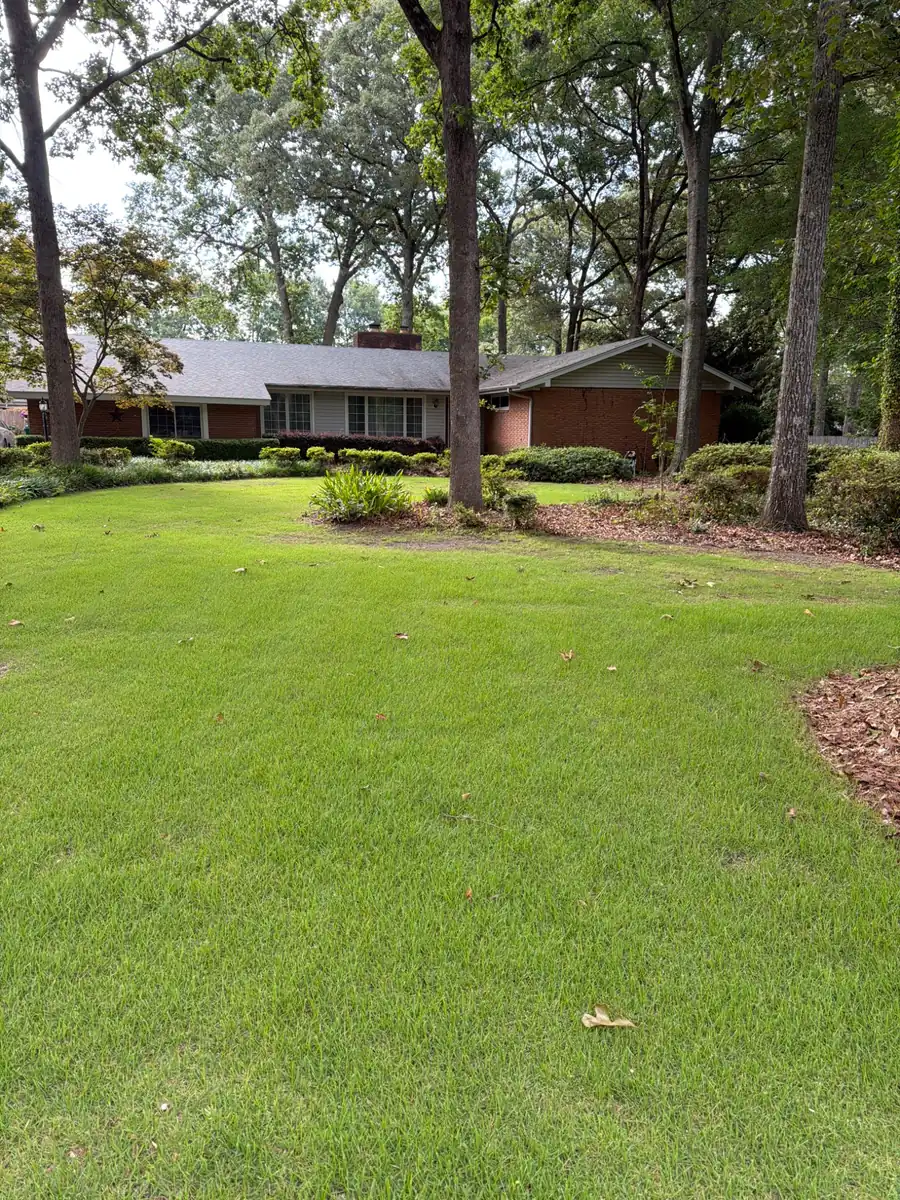
The Right Fertilizing Schedule for Middle Georgia Lawns
Fertilizing at the wrong time wastes money and can damage your lawn. Here's the fertilizing schedule we follow for Bermuda grass in Middle Georgia, and why timing matters more than the product.
We fertilize Bermuda in Middle Georgia from mid-April through mid-September. Wait for soil temps at 65°F and 50% green coverage before the first application. Then apply two to three times, spaced six to eight weeks apart, using slow-release nitrogen in summer. Finish with a potassium-forward blend in early September and stop all nitrogen after that.
Why Your Fertilizing Schedule Matters More Than the Fertilizer
Most homeowners spend more time picking the right fertilizer bag than figuring out when to apply it. That's backwards. A premium fertilizer applied at the wrong time either washes away, burns your grass, or feeds weeds instead of Bermuda.
Bermuda grass in Middle Georgia runs on a specific seasonal clock. Soil temperature drives everything. Apply nitrogen before your lawn is actively growing and it goes nowhere useful. Apply it too late in fall and you push tender growth into the frost window.
Get the timing right and Bermuda responds fast. Thick, green, and resistant to weeds. The product matters, but the calendar matters more.
When to Start Fertilizing Bermuda Grass in Middle Georgia
For Bermuda grass in USDA Zone 8a, the right time to start fertilizing is mid-April to early May, not before. That's the answer for homeowners in Macon, Warner Robins, Bonaire, and the surrounding area.
Bermuda breaks dormancy when soil temperatures consistently reach 65°F. In Middle Georgia, that happens between mid-March and early April depending on the year. But green-up alone isn't the signal to fertilize. You want at least 50% green coverage across the lawn before putting down nitrogen.
Fertilizing before that threshold means you're feeding soil and weeds, not Bermuda. We see this mistake every spring. Homeowners apply fertilizer in late February or March, then wonder why the lawn doesn't respond. The grass isn't ready to use it. Soil temps in Macon in February still drop into the 40s overnight, which means Bermuda root activity is near zero.
Don't fertilize Bermuda before soil temps reach 65°F consistently. Mid-April is the safe starting point in Middle Georgia.
Wait for 50% or more green coverage before the first application of the season.
If you're unsure about soil temperature, check the NOAA soil temp map or use an inexpensive probe thermometer.
Early May is often the sweet spot. Grass is fully active, soil is warm, and you avoid feeding cool-season weeds.
A Month-by-Month Fertilizing Schedule for Middle Georgia
The schedule below is what we follow for Bermuda lawns in the Macon, Warner Robins, Bonaire, and Kathleen areas. It's built around our climate, not a generic national chart.
The goal is to feed the lawn during its active growing window (late spring through summer) and stop completely before temperatures drop. Pushing nitrogen in October is one of the most common mistakes we see, and it directly increases frost damage risk.
Bermuda Grass Fertilizing Schedule: Middle Georgia (Zone 8a)
| Month | Action | Notes |
|---|---|---|
| January–February | No fertilizer | Bermuda is dormant. Soil temps below 50°F. |
| March | No fertilizer | Soil not consistently warm enough. Pre-emergent window instead. |
| Mid-April | First application | After 50%+ green-up. Balanced or nitrogen-forward fertilizer. |
| Late May–June | Second application | Lawn is fully active. Good time for slow-release nitrogen. |
| July | Optional application | Only if lawn shows deficiency. Skip if summer stress is high. |
| August | Light or skip | Summer heat stress: heavy nitrogen can invite disease. |
| Early to Mid-September | Final application | Last call. Use potassium-forward blend to prep for dormancy. |
| October–November | No fertilizer | Stop all nitrogen. Frost risk window begins. |
How Often to Fertilize During the Summer
For most Bermuda lawns in Middle Georgia, two to three fertilizer applications between May and mid-September is enough. Space them six to eight weeks apart. More frequent applications don't build a thicker lawn. They spike growth, increase mowing frequency, and raise disease risk.
Over-fertilizing in summer, especially with fast-release nitrogen, creates conditions favorable to large patch and other warm-season turf diseases. Slow-release nitrogen sources like sulfur-coated urea are better in summer because they feed the lawn gradually rather than spiking growth all at once.
Timing around rainfall matters too. Applying fertilizer right before heavy rain can wash product off the lawn before it's absorbed. The better window is when light rain is expected within 24 to 48 hours, or when you plan to irrigate lightly after application. In the Macon area, afternoon thunderstorms are common June through August, so we watch the forecast before each visit.
Space summer fertilizer applications six to eight weeks apart.
Use slow-release nitrogen in summer to avoid burning grass and raising disease risk.
Fertilize before expected light rain or water it in. Avoid applying right before a heavy storm.
If your Bermuda looks yellow in July, check for iron deficiency before adding more nitrogen.
Skip or reduce fertilizer during drought stress. A struggling lawn can't absorb nutrients effectively.
Fall Fertilizing: When to Stop and What to Use
Fall fertilizing in Georgia confuses many homeowners because advice written for the Northeast doesn't apply here. In Ohio or Massachusetts, October fertilization makes sense because cool-season grasses are actively growing. For Bermuda in Middle Georgia, October fertilization is a mistake.
Bermuda slows down in September as days shorten and soil temps begin to drop. The cutoff for nitrogen fertilizer is mid-September. Any nitrogen applied after that pushes soft new growth that has no time to harden before frost. When frost hits tender Bermuda, you get dieback that takes longer to recover from in spring.
The right move in early to mid-September is a potassium-forward fertilizer, something like a 0-0-50 or a blend with a high K number. Potassium helps the grass harden its cell walls, store energy for dormancy, and recover faster in spring. Georgia red clay soils are naturally low in potassium, so this application fills a real deficiency. University of Georgia Extension recommends potassium applications for Bermuda lawns in late summer for exactly this reason.
What Is a Poor Man's Fertilizer, and Does It Work
Poor man's fertilizer refers to snow. The idea is that snow contains trace amounts of nitrogen absorbed from the atmosphere as it falls, which releases into the soil when it melts. There is a small amount of nitrogen in snow, but in practical terms it's not meaningful for lawn nutrition. A few inches of snow delivers a negligible amount of actual nitrogen across your entire yard, not a substitute for a fertilizer program.
In Middle Georgia, snow is rare enough that this is largely a moot point for homeowners in Macon or Warner Robins. A more practical low-cost option is topdressing with finished compost in late spring. Compost adds slow-release nutrients and improves water retention in heavy clay soils. It works best alongside a standard fertilizer program, not instead of one.
Building a Fertilizing Schedule for New Sod
New Bermuda sod has different needs than an established lawn. Right after installation, the root system is shallow and the grass is stressed. Applying high-nitrogen fertilizer too soon can burn new roots and slow establishment.
For new sod in Middle Georgia, hold off on fertilizer for three to four weeks after installation. Focus on watering. Frequent shallow waterings in week one, then transitioning to deeper, less frequent irrigation as roots establish. Once the sod has knitted into the soil and resists a gentle tug, it's ready for its first fertilizer application.
A starter fertilizer with a balanced nitrogen-phosphorus-potassium ratio works well for new installations. After that first application, follow the standard schedule based on the time of year. If new sod goes down in late August or September, skip fertilizer for the season and start a full program the following mid-April. Pushing growth on new sod heading into dormancy creates more problems than it solves.
Wait three to four weeks before fertilizing new Bermuda sod. Let roots establish first.
Use a starter fertilizer with a balanced NPK ratio for the first application on new lawn.
If sod is installed in late summer, skip fertilizer and start a full program the following spring.
New lawns need more frequent watering initially. Focus on establishment before nutrition.
After the lawn passes the tug test, treat it like an established lawn going forward.
How We Handle Fertilization at Attaboy Lawn Care
Our core program covers weed control and fertilization together, because the two are connected. A well-fed lawn crowds out weeds. Weeds thin a lawn and force more herbicide. We treat them as one system.
We time every application around Middle Georgia's actual soil conditions, not a generic national schedule. After every visit, you get a treatment report so you know exactly what went down and when. If a treatment doesn't perform the way it should, we come back and re-treat at no charge. That's our free re-treatment guarantee.
Pricing is flat and monthly. No contracts. Cancel anytime. We serve Macon, Warner Robins, Bonaire, Kathleen, Byron, Centerville, and Bolingbroke. If your lawn is in Middle Georgia and you're tired of guessing at the fertilizer aisle, call us at (478) 400-9897 or get a Get Quote.
Key takeaways
What to Remember
Start fertilizing Bermuda in mid-April to early May, not before soil temps hit 65°F and 50% green coverage.
Apply fertilizer two to three times between May and mid-September, spaced six to eight weeks apart.
Stop all nitrogen by mid-September to protect Bermuda from frost damage heading into dormancy.
Use a potassium-forward fertilizer in early September to harden Bermuda before winter.
New sod needs three to four weeks of establishment before any fertilizer application.
Use slow-release nitrogen for summer applications when daytime temps regularly exceed 95°F.
Common questions
Frequently Asked Questions
What month should you start fertilizing your lawn in Middle Georgia?
Mid-April is the right starting point for Bermuda grass in Middle Georgia. Soil temperatures need to be consistently at 65°F and the lawn should have at least 50% green coverage before you apply nitrogen. Fertilizing in February or March is too early. The grass isn't actively growing and won't use the nutrients.
Is October too late to fertilize your lawn?
For Bermuda grass in Middle Georgia, yes. October is too late. The cutoff for nitrogen fertilizer is mid-September. Applying nitrogen in October pushes tender new growth right before frost, which leads to more dieback and a slower green-up the following spring. If you want to do something in September, use a potassium-forward fertilizer to help the lawn harden before dormancy.
What is a good fertilizer schedule for Bermuda grass?
For Middle Georgia Bermuda, a solid schedule looks like this: first application in mid-April after green-up, a second in late May or June, an optional third in July if the lawn shows deficiency, and a final potassium-forward application in early to mid-September. That's three to four applications total during the active growing season. No fertilizer from October through March.
What is the best fertilizer to put down in fall?
In early to mid-September (the last window before Bermuda slows down), use a fertilizer with a high potassium number and little or no nitrogen. A product labeled 0-0-50 or a blend with a high K number works well. Potassium strengthens cell walls, helps the grass store energy for winter, and supports faster green-up in spring. Georgia red clay soils tend to be naturally low in potassium, so this application fills a real need.
What is poor man's fertilizer?
Poor man's fertilizer is a nickname for snow, based on the idea that snowfall carries trace amounts of atmospheric nitrogen that release into the soil when it melts. The nitrogen content is real but too small to meaningfully support lawn nutrition. In Middle Georgia, snow is rare anyway. A more practical low-cost option is topdressing with finished compost in late spring, which adds slow-release nutrients and improves clay soil structure.
How often should you fertilize your lawn in summer?
For Bermuda grass in Middle Georgia, two applications during summer (one in late May or June and one in July if needed) is typically enough. Space applications six to eight weeks apart and use slow-release nitrogen to avoid burning the grass or raising disease risk during peak heat. Applying too much nitrogen in July and August when daytime temperatures exceed 95°F creates stress, not growth.
Keep reading
Related Resources
More in Lawn Tips

Written by Tyler Warnock
Founder and owner of Attaboy Lawn Care in Macon, Georgia. Licensed Georgia pesticide applicator (Cat. 24, #22324). Tyler treats lawns across Macon, Warner Robins, and the rest of Middle Georgia, and writes these guides from what the region’s bermuda, zoysia, and centipede yards actually do season to season.
Ready for results?
Get a Custom Quote for Your Lawn
Professional lawn care for Macon, Warner Robins, and Middle Georgia. No contracts, no obligation.