What to Look for in a Macon Lawn Care Company
Not every lawn care company knows Middle Georgia soil, grass, or climate. Here's how to tell the good ones from the ones who'll take your money and leave you with weeds.
Look for a valid Georgia Pesticide License, local knowledge of Bermuda grass and red clay, a free re-treatment guarantee, treatment reports after every visit, and flat monthly pricing with no contracts. Ask what gets applied, when, and why before you sign. Most lawns here start at $39 a month for weed control and fertilization, and the price rises with lawn size.
Why Hiring Local Knowledge Matters in Middle Georgia
Macon isn't just hot. It's Zone 8a hot. Bermuda grass dominates most lawns here, and it behaves differently than it does in Atlanta or Savannah. Soil temps in Middle Georgia hit 65°F between mid-March and early April, which is when Bermuda actually wakes up. A company that doesn't know that will fertilize too early, waste your money, and potentially push weak growth that gets burned off.
Georgia red clay is another local reality. It compacts hard, drains poorly, and tends to run acidic with low potassium. A lawn care company that treats Macon soil the same as sandy coastal soil will get mediocre results. The program needs to match the conditions. Not just a generic regional template.
We've been treating lawns in Macon, Warner Robins, Bonaire, and the surrounding Middle Georgia area long enough to know exactly what these lawns need by month. That local experience isn't something a national franchise can match from a call center in another state.
Ask any company you're considering: what grass type is most common in Macon? If they can't answer confidently, move on.
Find out if they know the difference between large patch and dollar spot. Both show up in Middle Georgia, and they require different treatments.
Ask when they recommend the first spring fertilization. If they say February or early March, they don't know Middle Georgia Bermuda.
5 Things to Check Before Hiring Anyone
Choosing a lawn care company feels overwhelming when every website looks the same. But a few specific questions will separate the serious operations from the ones running a truck and a prayer. Start with these before you hand over your credit card.
First, ask about licensing. In Georgia, any company applying pesticides, including weed control products, must hold a valid Georgia Pesticide License through the Georgia Department of Agriculture. This isn't optional. If they're spraying your lawn without it, they're operating illegally and you have zero protection if something goes wrong.
Second, ask what their treatment process looks like from start to finish. A solid company should be able to walk you through what they apply, when, and why, based on the time of year and your specific grass type. Vague answers like 'we handle everything' are a red flag. Third, find out how they communicate after each visit. Do you get a treatment report? A text? Nothing? You should always know what was applied to your lawn, especially if you have kids or pets. Fourth, ask about their guarantee policy. Re-treatments should be part of the deal, not an extra charge. Fifth, confirm their pricing structure upfront. Flat monthly pricing with no contracts is easier to manage than seasonal packages with buried fees.
Verify their Georgia Pesticide License number before signing anything.
Ask specifically: 'Do you send a treatment report after every visit?' If not, keep looking.
Request a clear explanation of what's included in the base program versus what costs extra.
Ask how quickly they can start. A reputable company should be able to begin within 24 hours for standard treatments.
National Chains vs. Local Companies. What You Actually Get
Companies like TruGreen and Lawn Doctor operate at scale. That scale comes with trade-offs. Technicians are often assigned to large route areas and may not be familiar with your specific neighborhood, soil type, or micro-climate. Macon's red clay behaves differently from soil even 30 miles away. That nuance matters.
With a local company, you're typically dealing with the same person or small team on every visit. They notice when something's off (a new weed pressure, early signs of large patch, or spots that stay wet too long). That kind of ongoing observation is hard to replicate when a different tech shows up each time from a regional dispatch center.
Local companies also tend to be faster when problems come up. If your lawn develops an issue between scheduled treatments, a local operation can get back out to you without navigating a corporate service queue. For most Macon homeowners, that responsiveness is worth more than a recognizable brand name.
How Pricing Actually Works, and What's Fair
Lawn care pricing in Middle Georgia varies based on lot size, service frequency, and what's included. Most lawns here start at $39 a month for weed control and fertilization, and the price rises with lawn size. Ask for the monthly number in writing before you sign, and ask what moves it: square footage, the services included, or both. A company that will not name a number until a salesperson is standing in your yard is one you cannot compare to anyone else.
As for hourly landscaping rates, $100 per hour for landscape work isn't unusual for specialty services (think irrigation installation or tree work), but standard lawn care should be quoted by the job or as a monthly program, not by the hour. Hourly billing with no cap is how costs spiral unpredictably. Flat monthly pricing lets you budget without surprises.
Watch out for companies that lead with a low introductory price and then add fees for every add-on. A clear quote should tell you exactly what's included (weed control, fertilization, any disease or insect control) and what would cost extra. We use flat monthly pricing with no contracts, so you always know what you're paying before the month starts.
Typical Lawn Care Pricing Factors in Middle Georgia
| Factor | Lower Cost | Higher Cost |
|---|---|---|
| Lawn size | Under 5,000 sq ft | Over 15,000 sq ft |
| Grass type | Bermuda (lower maintenance) | Zoysia or mixed turf |
| Services included | Weed control + fertilization only | Adds disease, insect, soil treatments |
| Contract requirement | No contract, cancel anytime | Annual contract with cancellation fees |
| Communication | Treatment reports after every visit | No follow-up after service |
Guarantees That Actually Mean Something
Every lawn care company claims to do good work. The ones worth hiring back it up with a guarantee. There are three specific guarantees that should matter to any Macon homeowner: no waiting around for a service window, no weeds coming back without a free re-treatment, and no anxiety about whether your lawn is being handled correctly.
The re-treatment guarantee is the most important one to ask about directly. Weeds don't always die on the first application. Post-emergent herbicides sometimes need a follow-up, especially on stubborn species like dallisgrass or nutsedge, which are common in Middle Georgia. A company that charges you again for that follow-up is charging you for their incomplete first job.
Pet and kid safety matters too. Ask any company you interview how long to keep pets and kids off the lawn after an application, and how they tell you the visit is done. For our treatments that is until the lawn is dry, and we text you when the visit is done and what we applied. If a company can't give you a straight answer on dry time and re-entry, that's a problem.
Ask directly: 'If weeds come back between treatments, do you re-treat at no charge?' Get the answer in writing.
Confirm how long you need to keep kids and pets off the lawn after treatment. The answer should be specific, not vague.
Find out what happens if you're not satisfied with a treatment result. A strong company offers a clear resolution path.
What the 1/3 Rule Means for Your Lawn Mowing
The 1/3 rule is one of the most practical guidelines in lawn care: never cut more than one-third of the grass blade in a single mowing. For Bermuda grass in Macon, which should be kept at 1 to 1.5 inches, that means mowing before it gets above 2 to 2.25 inches. Let it go too long and you create a thick mat of stems that turns brown when you finally cut it, a condition called scalping.
During Middle Georgia's summer months, Bermuda can grow fast enough that you may need to mow twice a week to stay within the 1/3 rule. That's not a problem with the grass. That's a sign of a healthy, actively growing lawn. The mistake is letting it get tall, then cutting it short in one pass and wondering why it looks terrible afterward.
A lawn care company worth hiring will reinforce this advice rather than ignore it. If a company never mentions mowing height or frequency when they're talking about your lawn's health, they're leaving a major factor out of the conversation.
Red Flags That Should Send You Looking Elsewhere
Some warning signs are obvious. No license, no insurance, no written quote. Others are subtler. Watch for companies that can't tell you what products they're using or why. A technician who shows up, sprays something quickly, and leaves without any documentation isn't running a professional operation.
Be cautious of companies that push you into annual contracts without explaining what you're locked into. A company confident in their results doesn't need to trap you with cancellation penalties. The same goes for companies that can't give you a start date. If they tell you it'll be 'a few weeks' before your first treatment, that's a sign of poor scheduling or high turnover in their crew.
Slow communication is another tell. If it takes days to get a quote or a return call during the busy spring season in Macon, expect the same slow response when there's a problem mid-summer. You want a company that treats your lawn like a real customer relationship, not a billing line item.
We treat our first service within 24 hours of signup for standard weed control and fertilization programs. We send a treatment report after every visit. No contracts, no cancellation fees, and free re-treatments if weeds come back. That's the standard we hold ourselves to, and it's the standard you should expect from any company you hire.
Key takeaways
What to Remember
Any company applying pesticides in Georgia must hold a valid Georgia Pesticide License. Verify it before hiring.
A good lawn care company knows Middle Georgia specifics: Bermuda green-up timing, red clay soil behavior, and local weed and disease pressure.
Flat monthly pricing with no contracts protects you from billing surprises and gives you flexibility to walk away if results don't show up.
Free re-treatments should be standard. If a company charges extra when weeds return, you're paying for their incomplete first job.
Treatment reports after every visit aren't a luxury. They're how you know what's being applied to your lawn and when.
Local companies typically respond faster to mid-season problems than national chains dispatching techs from regional centers.
Common questions
Frequently Asked Questions
What is the 1/3 rule for lawn care?
The 1/3 rule means you should never remove more than one-third of the grass blade in a single mowing. For Bermuda grass in Middle Georgia, which should be kept at 1 to 1.5 inches, that means cutting before it exceeds about 2.25 inches tall. Cutting too much at once shocks the lawn and exposes brown stems underneath, which is called scalping. During Macon's hot summers, Bermuda can grow fast enough that twice-weekly mowing keeps you within the rule.
Is $100 an hour too much for landscape work?
$100 an hour isn't unusual for specialty landscape work like irrigation installation, hardscaping, or tree services. But standard lawn care (weed control, fertilization, mowing) should be quoted as a monthly program or per-job rate, not by the hour. Hourly billing without a cap makes it hard to budget and easy for costs to balloon. Ask for flat pricing upfront so you know exactly what you're paying before the work starts.
Who is better, Lawn Doctor or TruGreen?
Both are national franchise operations, which means results depend heavily on the local franchise owner and the technicians assigned to your route. The bigger limitation with either is that national chains use standardized programs that may not account for Middle Georgia's specific soil, grass types, and climate. A local company familiar with Macon's red clay, Bermuda grass timing, and regional weed pressure will generally deliver more targeted results than a national brand running a one-size-fits-all program.
What should I look for in a lawn care service?
Start with licensing. In Georgia, any company applying pesticides must be licensed by the Georgia Department of Agriculture. Then look for clear pricing (flat monthly rates are easier to manage than hourly or packaged billing), a re-treatment guarantee if weeds come back, treatment reports after every visit, and local knowledge specific to your grass type and soil. A company that can explain what they're applying and why (based on your specific lawn and the time of year) is worth paying for.
What kills grass the quickest?
Non-selective herbicides like glyphosate will kill most grass types within days. But in Middle Georgia, the most common reasons grass dies are more gradual: prolonged drought stress, large patch fungal disease during wet fall and spring conditions, grub damage destroying root systems underground, or over-fertilizing with nitrogen too late in the season (after mid-September), which pushes tender growth that's vulnerable when the first cold snap hits.
What is 'poor man's grass'?
Centipede grass is sometimes called poor man's grass because it requires very little fertilization and minimal maintenance compared to Bermuda or Zoysia. It grows slowly, stays low, and tolerates the acidic red clay soil common in Middle Georgia reasonably well. The trade-off is that it doesn't handle heavy foot traffic or drought stress as well as Bermuda, and it's sensitive to over-fertilization. Too much nitrogen will actually damage it.
Keep reading
Related Resources
More in Local Guides
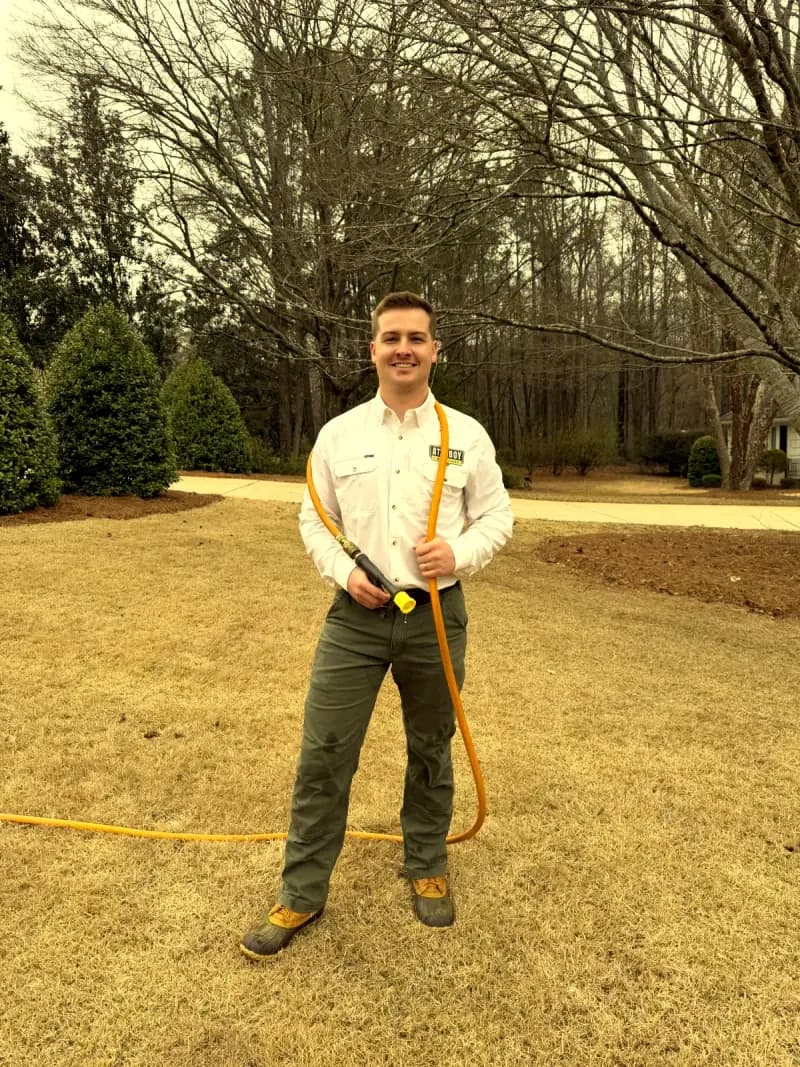
Written by Tyler Warnock
Founder and owner of Attaboy Lawn Care in Macon, Georgia. Licensed Georgia pesticide applicator (Cat. 24, #22324). Tyler treats lawns across Macon, Warner Robins, and the rest of Middle Georgia, and writes these guides from what the region’s bermuda, zoysia, and centipede yards actually do season to season.
Ready for results?
Get a Custom Quote for Your Lawn
Professional lawn care for Macon, Warner Robins, and Middle Georgia. No contracts, no obligation.