Granular vs Liquid Fertilizer
Both deliver nutrients to your lawn, but they work differently. Here is when each type makes the most sense.
Overview
What This Comparison Covers
Walk into any garden center and you will find bags of granular fertilizer next to bottles of liquid concentrate. Both contain the same basic nutrients (nitrogen, phosphorus, and potassium), but they deliver them differently. Granular fertilizer releases slowly over weeks. Liquid fertilizer is absorbed quickly for fast results. Most professional lawn care programs use both at different times for different reasons. This comparison explains the differences so you understand what is going on your lawn and why.
Head to head
Side-by-Side Comparison
Granular Fertilizer
Pros
Slow-release formulas feed your lawn steadily over 6-8 weeks
Lower risk of burning your lawn when applied correctly
Easier to see where you have already applied (visible granules)
Less frequent application needed (saves trips to the yard)
Better for building long-term soil nutrient levels
Cons
- Requires water to activate, ineffective in dry conditions without irrigation
- Uneven distribution from cheap spreaders leads to striping
- Slower visible response compared to liquid
- Granules can bounce off slopes and collect in low spots
- Not ideal for quick micronutrient corrections
Best for:
The backbone of a fertilization program. Best for consistent, sustained feeding throughout the growing season.
Liquid Fertilizer
Pros
Rapid absorption through leaves and roots for fast greening
Excellent for targeted micronutrient applications (iron, manganese)
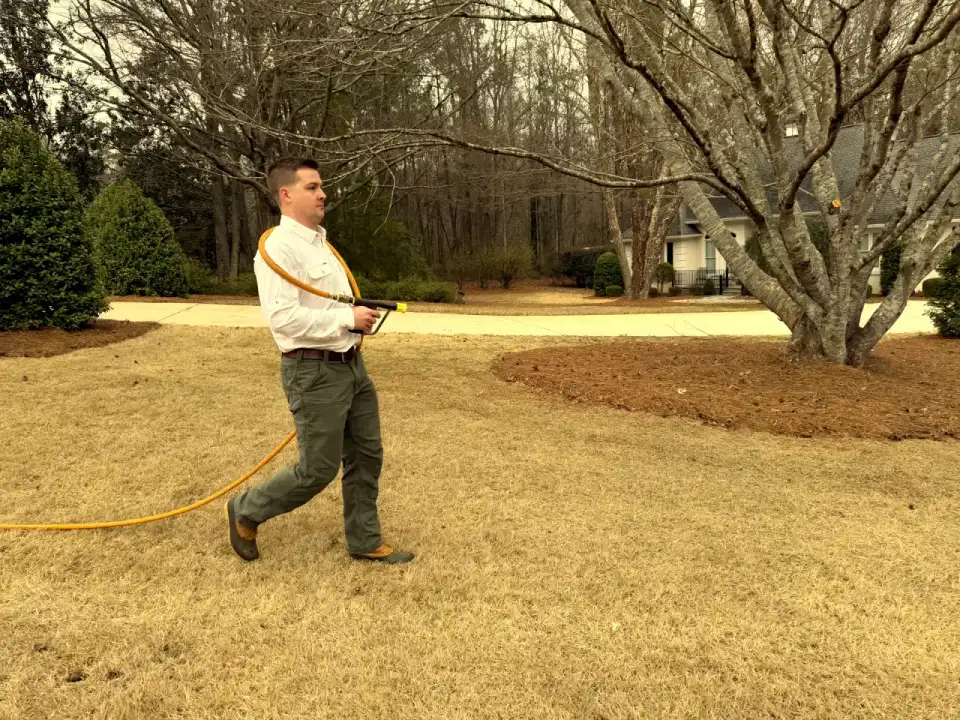
Even coverage when applied with professional spray equipment
Can be tank-mixed with herbicides for efficient combined applications
Ideal for quick corrections when the lawn needs an immediate boost
Cons
- Shorter duration. Nutrients are used up within 2-3 weeks
- Higher burn risk if over-applied, especially in hot weather
- More frequent applications needed for sustained results
- Requires calibrated spray equipment for even distribution
- Wind drift can cause uneven application
Best for:
Quick green-up, micronutrient supplementation, and combined applications with weed control products.
Factor by factor
Detailed Comparison
Factor
Granular Fertilizer
Liquid Fertilizer
Nutrient Release Speed
Granular Fertilizer
Slow-release over 6-8 weeks
Liquid Fertilizer
Fast absorption within days
Nutrient Release Speed
Slow-release over 6-8 weeks
Fast absorption within days
Duration of Effect
Granular Fertilizer
6-8 weeks per application
Liquid Fertilizer
2-3 weeks per application
Duration of Effect
6-8 weeks per application
2-3 weeks per application
Burn Risk
Granular Fertilizer
Lower (slow-release buffers the nitrogen)
Liquid Fertilizer
Higher (concentrated solution applied directly)
Burn Risk
Lower (slow-release buffers the nitrogen)
Higher (concentrated solution applied directly)
Application Ease (DIY)
Granular Fertilizer
Broadcast spreader (moderate skill needed)
Liquid Fertilizer
Spray equipment (higher skill and equipment needed)
Application Ease (DIY)
Broadcast spreader (moderate skill needed)
Spray equipment (higher skill and equipment needed)
Coverage Uniformity
Granular Fertilizer
Good with calibrated spreader, streaky with cheap ones
Liquid Fertilizer
Excellent with professional spray rigs
Coverage Uniformity
Good with calibrated spreader, streaky with cheap ones
Excellent with professional spray rigs
Best Season in Middle Georgia
Granular Fertilizer
Spring and summer for sustained feeding
Liquid Fertilizer
Spring green-up and fall micronutrient correction
Best Season in Middle Georgia
Spring and summer for sustained feeding
Spring green-up and fall micronutrient correction
Micronutrient Delivery
Granular Fertilizer
Limited, better for macronutrients (N-P-K)
Liquid Fertilizer
Excellent for iron, manganese, and other micros
Micronutrient Delivery
Limited, better for macronutrients (N-P-K)
Excellent for iron, manganese, and other micros
Cost
Granular Fertilizer
Lower per application
Liquid Fertilizer
Higher per application (but fewer pounds needed)
Cost
Lower per application
Higher per application (but fewer pounds needed)
The verdict
Bottom Line Verdict
Granular and liquid fertilizer are not an either-or decision. The best lawn care programs use granular as the foundation for sustained feeding and liquid for targeted corrections, quick green-up, and combined applications with weed control. For Middle Georgia bermuda and zoysia lawns that need 2-5 pounds of nitrogen per 1,000 square feet per year, a mix of both types delivers the most consistent, even results across the entire growing season.
Why Attaboy
What Attaboy Does Differently
Common questions
Frequently Asked Questions
Can I use granular and liquid fertilizer together?
Yes, and most professional programs do. Granular provides the slow-release nitrogen base, while liquid applications deliver quick-response micronutrients and can be combined with weed control treatments. Using both gives you the best of sustained feeding and rapid correction.
Which fertilizer type is better for bermuda grass?
Bermuda grass is a heavy feeder that benefits from both. Granular slow-release nitrogen in spring and summer provides the consistent feeding bermuda needs, while liquid iron applications enhance color without pushing excessive top growth. Most professional bermuda programs use a combination.
Will liquid fertilizer burn my lawn?
It can, especially if over-applied or applied during extreme heat. Professional applicators calibrate their spray equipment to deliver the correct rate and avoid application when temperatures exceed 90 degrees. DIY liquid application carries higher burn risk due to equipment variability.
How often should I fertilize in Middle Georgia?
Bermuda grass lawns benefit from 4-6 fertilizer applications between April and September. Zoysia needs slightly less, and centipede needs the least, only 1-2 light applications per year. Over-fertilizing centipede is one of the most common DIY mistakes in Middle Georgia.
Does the type of nitrogen in fertilizer matter?
Yes. Slow-release nitrogen sources like polymer-coated urea or methylene urea feed your lawn gradually and reduce the risk of burning. Quick-release nitrogen (like urea alone) provides fast green-up but burns off quickly and carries higher risk. Professional-grade products typically use a blend of both for balanced feeding.
Related guides
Continue Your Research
Ready to compare results?
Get a Free Custom Quote for Your Lawn
Tell us about your yard and we will build a treatment program matched to your grass type, soil conditions, and goals.